 How-to
7 Commercial Overhead Door Service Mistakes Denver Businesses Make
Last Updated: October 25, 2026
Quick Summary
Commercial overhead door service in Denver requires a dedicated commercial technician, not residential work, because high-cycle doors carry heavier springs, reinforced tracks, and operators built for far more cycles. Schedule professional service quarterly for high-cycle doors, twice a year for medium-cycle, and annually for low-cycle, with monthly staff safety checks logged in writing.
- High-cycle doors need monthly staff safety checks and professional service quarterly.
- Medium-cycle doors need professional service twice a year; low-cycle doors annually.
- Get a written estimate listing parts, labor, balancing, safety testing, and exclusions.
- Ask for a certificate of insurance and warranty terms before comparing quotes.
- Have door make, model, symptom, and an on-site contact ready for emergency calls.
Table of Contents
- Why Commercial Overhead Door Service in Denver Demands a Different Approach
- Mistake 1: Treating Commercial Overhead Door Repair Like Residential Work
- Mistake 2: Guessing at Commercial Garage Door Repair Cost Instead of Reading the Estimate
- Mistake 3: Skipping Commercial Door Maintenance Until Something Breaks
- Mistake 4: Calling for Commercial Overhead Door Emergency Repair Without a Plan
- Mistake 5: Choosing a Service Provider on Price Alone
- Mistake 6: Ignoring Safety, Compliance, and Operational Risk
- Schedule Your Commercial Overhead Door Service Before the Next Breakdown
- Frequently Asked Questions
Why Commercial Overhead Door Service in Denver Demands a Different Approach
Commercial overhead door service in Denver is not a scaled-up version of residential garage door work.
A commercial overhead door is a large, high-cycle door system built for vehicle traffic, freight handling, and daily industrial use.
Below, we walk through the seven mistakes we run into most, and what to do instead. Each one is fixable, and fixing them early is cheaper than fixing them after a breakdown.
Mistake 1: Treating Commercial Overhead Door Repair Like Residential Work
The first mistake is assuming the technician who fixes your house can handle your warehouse. Residential and commercial doors carry different spring systems, different track gauges, and different operator logic.
That matters for safety. High-cycle torsion springs store enormous force, and releasing that tension without the right winding bars and the right procedure is how injuries happen.
If your building runs on a loading dock schedule, the repair has to be planned around it, not dropped in whenever a truck happens to be clear. Businesses that need that dedicated commercial focus can look at commercial garage door service built for industrial sites.
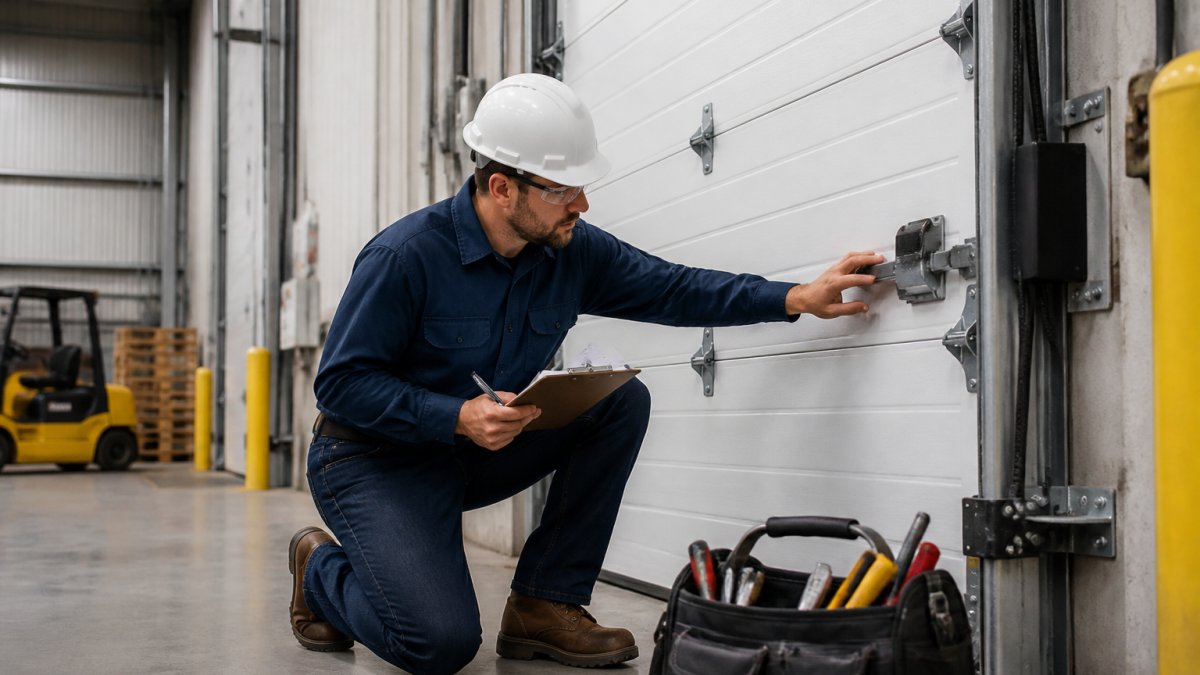
Mistake 2: Guessing at Commercial Garage Door Repair Cost Instead of Reading the Estimate
Commercial garage door repair cost depends on what actually failed, not on a flat rate someone quotes over the phone.
A proper estimate breaks down parts, labor, and any required adjustments. Ask what is included and what is not.
We do not publish fixed prices because the honest answer is that scope drives the number. Get a written estimate that lists the specific components being replaced.
Mistake 3: Skipping Commercial Door Maintenance Until Something Breaks
Reactive repair is the most expensive way to run a door system. Commercial door maintenance is what keeps a door from becoming an emergency, and it costs a fraction of a breakdown.
The problem with most maintenance advice is that it stops at "inspect regularly." Facility managers need a cadence and a record, not a slogan. Below is a recommended schedule and checklist for commercial and industrial doors, which can be adjusted for how hard the door actually works.
Recommended inspection cadence by duty cycle
- High-cycle doors (loading docks, distribution, retail with constant traffic, think dozens to hundreds of cycles per day): monthly visual and safety check by staff, professional service quarterly.
- Medium-cycle doors (shops, service bays, mixed-use commercial): monthly safety check by staff, professional service twice a year.
- Low-cycle doors (storage, back-of-house, occasional access): monthly safety check by staff, professional service annually.
These are starting points, not rules. A door on a busy dock in July is working harder than the same door in January, and a door that has already had a spring or cable replaced should be watched more closely for the first few months.
The monthly staff safety check
This is a five-minute walk-around that any trained employee can do without tools and without touching springs, cables, or the operator's internal components:
- Safety reversal test: place a solid object in the door's path and confirm the door reverses on contact. If it does not, take the door out of service and call for service.
- Photo-eye test: block the photo-eye beam and confirm the door will not close, or reverses if already closing.
- Visual walk-around: look for frayed cables, broken or stretched springs, bent tracks, loose hinges, missing fasteners, and damaged weather seal or bottom astragal.
- Listen: note any new grinding, popping, or uneven travel. Noise is data.
The professional service visit
A qualified technician should go beyond the staff check and cover the mechanicals that are unsafe or impractical for staff to touch:
- Spring tension, cable condition, and drum wear
- Roller, hinge, and bearing wear; fastener torque
- Track alignment, plumb, and anchor condition
- Operator settings, limit switches, safety reversal, and photo-eye function
A common mistake is waiting for a loud bang or a door that stops halfway. By then you are paying emergency rates and losing operating hours. The schedule above catches wear while it is still a cheap fix, and the log turns maintenance from a habit into a record.
Here is the recommended inspection cadence by how hard the door actually works.
| Door duty cycle | Examples | Staff check | Professional service |
|---|---|---|---|
| High-cycle | Loading docks, distribution, retail with constant traffic | Monthly visual and safety check | Quarterly |
| Medium-cycle | Shops, service bays, mixed-use commercial | Monthly safety check | Twice a year |
| Low-cycle | Storage, back-of-house, occasional access | Monthly safety check | Annually |
Mistake 4: Calling for Commercial Overhead Door Emergency Repair Without a Plan
When a door jams at 2 a.m. with a truck waiting, panic calls happen. The businesses that recover fastest are the ones that already know who they will call and what information to have ready.
Have these ready before you need them:
- The door's make and model, if known
- A description of the symptom: stuck open, stuck closed, off track, or noisy operation
- Whether the door is blocking a fire exit or a dock
- A contact who can meet the technician on site
A provider that genuinely offers round-the-clock response will confirm availability when you call, not after you have waited. If you want a number on file before the next jam, emergency garage door repair is available around the clock.
Mistake 5: Choosing a Service Provider on Price Alone
The lowest quote often hides the highest total cost. Cheap work tends to mean generic parts, a rushed diagnosis, and no follow-up when the same door fails again in a month.
What most provider-selection advice misses is that "choose a good provider" is not actionable. Facility managers need questions to ask, documents to request, and a way to compare two quotes that look similar on paper.
Verify before you compare price
- Commercial experience, specifically. Ask how many commercial doors the company services per month and what types, sectional overhead, rolling steel, high-speed, fire-rated, dock equipment. A residential-only shop is not the right call for a loading dock.
- Licensing and insurance. Ask for a certificate of insurance showing general liability and workers' compensation coverage, and confirm the policy is current. A provider working on your property without coverage is your risk, not theirs.
- Technician qualifications. Ask whether technicians are trained on commercial operators and high-cycle spring systems, and whether the company follows a written safety procedure for spring work.
- Parts sourcing. Ask whether common parts are stocked locally or ordered per job. Stocked parts mean same-day or next-day repair; ordered parts mean days of downtime.
Compare quotes on scope, not just total
Two quotes for the same symptom can differ because they cover different work. When you compare, line up the following:
- Specific parts listed (brand, model, or specification where possible) versus "spring replacement" with no detail
- Labor included and estimated hours
- Balancing and adjustment after the repair, an unbalanced door wears out new parts fast
- Safety testing (reversal and photo-eye) included in the price
A written estimate that lists components, labor, and exclusions is the minimum. If a provider will not put scope in writing, that is the answer to your comparison.
Red flags worth walking away from
- A firm price quoted over the phone before anyone has seen the door
- No certificate of insurance available on request
- No written estimate or a one-line estimate with no parts detail
- Pressure to approve work on the spot before you have seen the scope
- No after-hours contact or dispatch process for a door that matters to operations
A local provider with a real stake in the community tends to answer the phone and show up. If you are comparing options, it helps to understand why a local garage door expert can be a safer call for a business that cannot afford repeat failures.
Mistake 6: Ignoring Safety, Compliance, and Operational Risk
A commercial door is a piece of safety equipment as much as it is an entrance. Failed springs, broken cables, and misadjusted operators create real injury risk for employees and customers.
Compliance matters too. Doors on fire-rated openings and exits have to function as designed, and a door that will not open reliably is an operational and liability problem, not just an inconvenience.
The practical fix is simple. Test the safety features monthly, log the results, and have a professional inspect the mechanicals on a schedule.
Schedule Your Commercial Overhead Door Service Before the Next Breakdown
Most of the mistakes above come down to one habit: waiting. Waiting to read the estimate, waiting to schedule maintenance, waiting to line up an emergency contact until the door is already stuck.
Garage Door Connection handles commercial overhead door service across Bennett, Aurora, and the Denver area.
Get started with Garage Door Connection and keep your doors running before the next breakdown. Reach out through our contact page to request service or a free quote.
Frequently Asked Questions
How much does commercial garage door repair cost in Denver?
Commercial garage door repair cost depends on the door type, the failed component, and whether the work is scheduled or after hours. A commercial overhead door repair might involve a single torsion spring, a section replacement, or a full operator rebuild, and each carries a different labor and parts profile. Because pricing varies by site and scope, ask for a written estimate that separates parts, labor, and any emergency surcharge. Garage Door Connection can provide a free quote based on your specific door and issue.
What should I look for in a commercial overhead door service provider?
Look for documented commercial experience, stocked service trucks, and a clear response-time commitment. Ask whether the company provides a written inspection report after each visit. Confirm insurance and ask for references from similar facilities. A provider that serves Denver and the Front Range should also explain how it handles after-hours calls and whether emergency service carries a premium.
How do I reset a commercial overhead door after a fault?
Start by checking the operator's fault code on its control panel, then clear the obstruction or re-engage the manual release according to the manufacturer's instructions. Many commercial operators require a power cycle and a limit reset before normal operation resumes. If the door still will not cycle, stop and call a technician. Repeated resets can mask a failing spring, misaligned track, or sensor fault, and forcing the door risks damage to the operator and the door sections.
When should a commercial overhead door be repaired instead of replaced?
Repair makes sense when the door structure is sound and the problem is isolated, such as a broken spring, worn rollers, or a failed opener component. Replacement is worth considering when sections are rusted through, the door is frequently out of alignment, or repair costs approach a significant share of a new installation. A technician can inspect hinges, tracks, and panels to give you a clear recommendation. For older doors, ask whether modern operators and safety features can be fitted without a full replacement.
If your overhead doors are due for inspection or you are tired of reactive repairs, the fix starts with one call. Garage Door Connection offers rapid 24/7 emergency response, safe spring replacement with the right equipment, and service built for Colorado's temperature swings. Get started with Garage Door Connection and schedule service before the next failure catches you off guard.