 How-to
How to Make Your Garage Door Opener Battery Backup Reliable
Last Updated: November 1, 2026
Quick Summary
Battery backup reliability depends on battery age, testing habits, and the conditions the battery lives in. Run a three-cycle load test every six months, treat the battery as a replacement candidate at 3 years, and replace it at 5 years even if it still passes. Heat is the single biggest driver of early failure, so plan on the low end of the 2-5 year lifespan in a hot garage.
- Test the backup by cutting power and counting full door cycles on battery alone.
- Fully charge the battery for at least 24 hours before running a load test.
- A battery that reads fine at rest but sags under load is weak.
- Store spare batteries between about 50°F and 80°F and rotate the oldest first.
- Replace the battery at 5 years full stop, even if it still passes.
Table of Contents
- Why Garage Door Opener Battery Backup Reliability Matters
- How to Test Garage Door Opener Battery Backup Safely
- Garage Door Opener Backup Battery Lifespan: What to Expect
- Signs Your Backup Battery Is Failing Before an Outage
- Garage Door Opener Battery Backup Troubleshooting
- Garage Door Opener Battery Replacement: When and How
- Schedule a Backup Battery Inspection with Garage Door Connection
- Frequently Asked Questions
Why Garage Door Opener Battery Backup Reliability Matters
A garage door opener battery backup is a standby power source that lets your door open and close when the grid fails, and battery backup reliability is what makes that promise hold up.
A dead backup battery is worse than none: it gives false confidence until the night the power drops and the door will not budge.
Reliability depends on three things: battery age, testing habits, and the conditions the battery lives in. Below, we show you how to test your backup, spot a failing battery early, and keep it ready for an outage.
How a Backup Battery Works During a Power Outage
Most openers use a sealed lead-acid or lithium battery that stays charged off your home's main power. When the power supply cuts out, the opener switches to the battery automatically.
The battery runs the opener motor, lights, and safety sensors, not forever, just enough cycles to get your car out or back in.
What a Backup Battery Can and Cannot Do
A backup battery keeps your door working during a short outage. It is not a generator, and it does not promise unlimited cycles.
What it can do:
- Open and close the door a limited number of times during an outage
- Keep the safety sensors and lights working
- Give you emergency access when the power is out
What it cannot do:
- Run the door all day during a long outage
- Replace a worn-out battery that no longer holds a charge
- Fix a separate opener problem, like a bad logic board
A common mistake is expecting years-old neglect to perform like new. The battery drains and ages even when you never use it.
How to Test Garage Door Opener Battery Backup Safely
You can test a garage door opener battery backup by cutting power to the opener and running the door on battery alone.
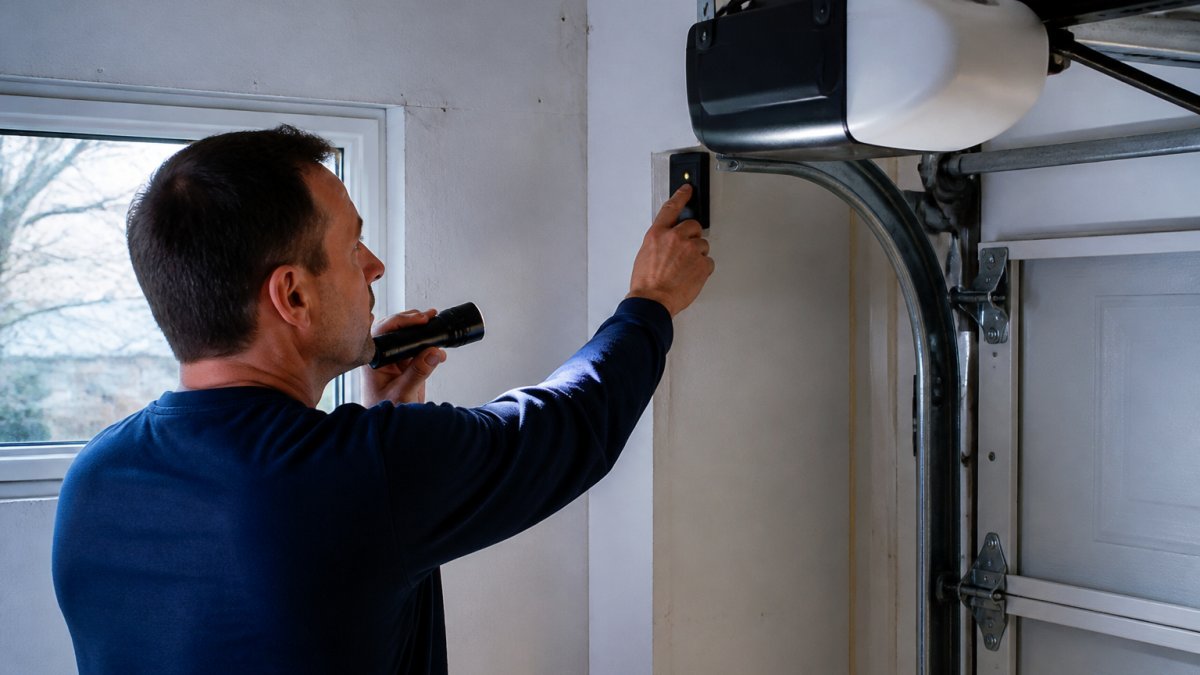
Here is the safe way to do it:
- Clear the door's path and make sure no one is under it
- Unplug the opener or flip its breaker
- Press the wall control and watch the door cycle
Never stand under a moving door during a test. If the door reverses or stops halfway, stop and check the battery and safety sensors.
A Repeatable Load-Test Procedure
A load test measures how the battery handles the real weight of your door, not just a quick open. Run it twice a year, and always before winter.
- Note the door weight and opener model for comparison over time.
- Fully charge the battery on main power for at least 24 hours.
- Cut power and run three full open-and-close cycles back to back.
- Record the third cycle, a strong battery keeps full speed.
- Note any slowdown, dimming lights, or beeping alert.
- Restore power and log the date.
If the door slows or the lights dim by the third cycle, the battery is losing capacity. A fresh battery handles several cycles without strain.
Garage Door Opener Backup Battery Lifespan: What to Expect
Backup battery lifespan varies with chemistry, heat exposure, charging behavior, and discharge depth. But lifespan depends on chemistry, heat exposure, charging behavior, and discharge depth.
Battery Age vs. Outage Runtime
Battery age and outage runtime are two different numbers, and mixing them up is the biggest source of confusion.
- Battery lifespan is how many years the battery lasts before replacement.
- Outage runtime is how many cycles it delivers during a single power interruption.
A two-year-old battery stressed by heat or deep discharges can still deliver weak runtime. Age alone does not prove reliability, the load test does.
Lifespan is a calendar question; runtime is a capacity question. A five-year-old battery in a cool garage that was never deep-discharged may still pass a three-cycle load test, while a two-year-old battery in a south-facing garage hitting 100°F+ may fail it.
What Actually Shortens Battery Life
Four factors do most of the damage, and they compound:
- Heat. A sealed lead-acid battery loses capacity faster at elevated temperatures, heat is one of the main factors that shortens service life (Battery University). A garage baking at 95-100°F in summer is genuinely harsh for a standby battery.
- Chronic undercharging. A battery that never reaches full charge sulfates and loses capacity, the failure mode most homeowners never see coming.
- Deep discharge. Each long outage that runs the battery to empty costs capacity; a handful can age it faster than years of standby.
- Age at installation. A replacement that sat on a shelf for a year starts its service life already behind. Check the date code when you buy.
Battery Type Trade-Offs
The two chemistries you will encounter behave differently, and the trade-offs matter for reliability planning:
- Sealed lead-acid (SLA) is the most common backup chemistry. It is inexpensive, widely compatible, and easy to recycle, but it is heavy, sensitive to heat, and degrades steadily even when unused. Expect the shorter end of the 2-5 year range in a hot garage.
- Lithium (often lithium-iron-phosphate) holds up better in heat, tolerates more cycles, and is lighter, but it costs more up front and must match the opener's charging profile, you cannot simply swap chemistry without confirming the opener supports it.
Neither chemistry is "reliable" in the abstract. Reliability comes from matching the battery to the opener, the climate, and your testing habits.
Temperature, Storage, and Charging Effects
Cold and heat shorten battery life differently. In a cold garage, a battery holds less charge and delivers fewer cycles during an outage, capacity drops noticeably near freezing. In a hot garage, it ages faster and can lose capacity permanently.
Charging matters just as much: a battery that never gets a full charge, or sits on a failing charging system, will not be ready when you need it. For a deeper look at cold effects, read our guide on smart garage opener cold weather performance.
Store a spare in a cool, dry spot, ideally between about 50°F and 80°F, away from concrete floors and damp corners.
A Practical Inspection Cadence
Use the lifespan range to schedule, not to assume:
- Every 6 months: run the load test described above and log the result.
- Every 12 months: inspect terminals for corrosion, check the battery case for swelling, and confirm the opener's charging indicator behaves normally after a full recharge.
- At 3 years: treat the battery as a candidate for replacement regardless of test results, especially in a hot garage.
That cadence turns a vague "2 to 5 years" into a schedule you can follow, catching the slow decline a once-a-year glance never will.
Here is the inspection cadence the article recommends for turning the 2-5 year lifespan range into a schedule you can follow.
| Interval | What to do | Note |
|---|---|---|
| Every 6 months | Run the load test and log the result | Catches slow decline |
| Every 12 months | Inspect terminals, check case for swelling, confirm charging indicator | After a full recharge |
| At 3 years | Treat battery as a replacement candidate | Especially in a hot garage |
| At 5 years | Replace it, full stop | Even if it still passes |
Signs Your Backup Battery Is Failing Before an Outage
The best time to catch a bad battery is before the power goes out. Your opener usually warns you first, if you know what to look for.
Watch for these warning signs:
- The status light flashes a low battery code
- The opener beeps at odd times with no command
- The door moves slower than usual on battery power
A beeping alert or warning indicator is your opener telling you the battery is weak. Do not ignore it. A dead battery fails silently the night you need it most.
Garage Door Opener Battery Backup Troubleshooting
If your backup will not hold a charge or the door will not run on battery, figure out which component failed. A weak battery, a charging fault, and an opener fault can all produce the same symptom, and the fix differs for each.
Step 1: Rule Out the Simple Stuff
Start with the checks that cost nothing and explain a surprising share of "failed" backups:
- Confirm the opener has main power and the battery is seated firmly in its compartment.
- Charge the battery fully for 24 hours, then retest.
- Check the battery terminals for corrosion and clean them.
If the door binds or the springs are weak, the opener may be straining, and a strained opener drains a healthy battery fast, which looks like a battery problem but is not. If the door is stuck, our 24/7 emergency garage door repair team can help any hour. If the opener acts strange after a battery swap or outage, our guide on how to reset a garage door opener walks you through the fix.
Step 2: Read the Warning Signs Correctly
Your opener usually tells you what is wrong before the power ever goes out, if you know how to read it. Match the symptom to the likely cause:
- Repeated beeping with no command: most often a low-battery or backup-fault alert. Note the pattern; many openers use a distinct sequence for battery versus safety-sensor faults.
- Status light flashing a specific code: consult your manual, the code usually points to battery, charging, or sensor. Steady and flashing lights mean different things.
- Door slows or lights dim on battery power: classic weak-battery-under-load symptom, capacity on paper but not under the motor's draw.
Step 3: Separate a Weak Battery from a Charging or Opener Fault
This is the diagnostic step most guides skip, and it saves you from replacing a good battery, or from replacing a battery when the real problem is the opener.
- Charge on main power for a full 24 hours to give the charging circuit every chance to top the battery off.
- Measure resting voltage with a multimeter after a few minutes off the charger. Measure the resting voltage with a multimeter and compare it against the battery manufacturer's specification. (Lithium packs read differently, check your opener's spec.)
- Run the three-cycle load test and watch voltage under load. A battery that reads fine at rest but sags sharply under load is weak, even if it is not old.
- Recharge and re-measure. If it returns to full resting voltage and passes the load test, the battery is fine, the original problem was likely a one-time deep discharge or a loose connection.
- If it will not recover, swap in a known-good battery of the correct type. If the new battery also fails to hold a charge, the fault is in the opener's charging circuit.
That swap is the cleanest test: a fresh battery that still will not charge proves the opener is the problem.
Step 4: Know When to Stop and Call
Some faults are not homeowner fixes. Call a technician if:
- A known-good battery will not charge on the opener.
- The opener never transfers to battery power during a simulated outage.
- You see burning smells, scorch marks, or repeated breaker trips.
Garage Door Opener Battery Replacement: When and How
Replace the battery when it fails a load test, shows physical damage, or reaches the end of its service life, for most homeowners, every 2 to 5 years, or sooner in a hot garage.
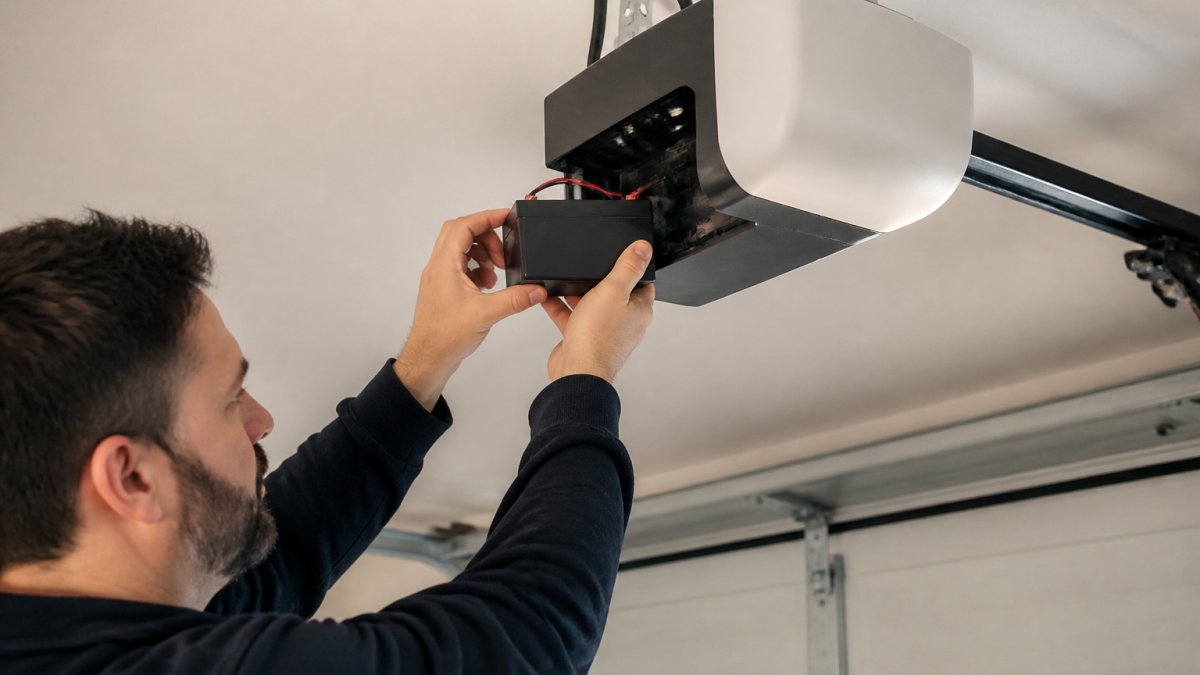
- Match the replacement battery to your opener model for battery compatibility
- Cut power to the opener before you start
- Remove the old battery and note how it sits
Dispose of the old battery at a local recycling center that accepts batteries. Do not toss it in household trash (the EPA).
Keep a spare battery on hand if you live where outages are common. It is cheap insurance for reliable operation.
Schedule a Backup Battery Inspection with Garage Door Connection
Testing your own backup is a good habit, and a professional inspection can help you check the system more thoroughly.
Garage Door Connection offers advanced openers with smartphone control and battery backups designed for the Colorado climate.
Ready to make your backup reliable? Contact us to schedule a backup battery inspection, or explore our garage door opener repair and installation services to upgrade to a quieter, smarter opener with a fresh backup battery.
Frequently Asked Questions
How reliable are garage door opener battery backups during a power outage?
A backup battery in good condition will open and close your garage door several times during an outage, but reliability depends on battery age, charge level, and door weight. Most units are designed for limited standby power, not extended use. Test the battery every few months by unplugging the opener and running the door. If it struggles or the status light warns of a low battery, replace it before the next storm season.
How long does a garage door opener backup battery last?
Garage door opener backup battery lifespan depends on climate and charging habits. Colorado temperature swings can shorten service life, so inspect the battery annually. Replace it at the first sign of a weak charge, beeping alert, or slow door operation rather than waiting for a full failure.
How do I know if my garage door opener backup battery is working?
Check the status light on the opener and listen for beeping alerts, which often signal a low battery. Then run a simple test: unplug the opener from mains power and press the wall control or remote. The door should move smoothly on battery power. If it moves slowly, stops partway, or the opener beeps repeatedly, the battery needs charging or replacement.
Can a garage door opener battery backup fail even if the opener works normally?
Yes. The opener can run fine on mains power while the backup battery sits dead or degraded, because the charging system may not be keeping it topped off. That is why regular testing matters. Watch for a warning indicator, a dead battery after an outage, or a battery that will not hold a charge. Replace it promptly and keep a spare battery on hand for reliable operation.
A reliable backup battery is not a set-and-forget feature. It needs a test twice a year, a replacement every few years, and a check of the charging system that keeps it ready. Garage Door Connection can handle all of it for you, from battery inspection and replacement to full opener installation with smartphone control and battery backups. Get started with Garage Door Connection and know your door will open the next time the lights go out.